
China’s AI build-out is real, but the bottlenecks are physical
Announcements in compute, memory and robotics matter only if power, parts and deployments follow.
 Rafael ImaiCompute, chips and power

China’s state-linked technology push is visible in a tripled Inner Mongolia compute hub, memory architecture work and factory robotics pilots. The market signals—southbound flows and a regulator symposium—are softer evidence than physical deployment. The key constraint is not ambition, but power, chips, cooling and utilization.
A data-center expansion in Inner Mongolia can be announced in a quarter, but the machines that fill it are bought, powered and cooled over years. China’s state-backed technology push is showing up in capacity statements, factory pilots and market signals, yet the hard part remains physical: who supplies the chips, who signs the power contract, and who turns a logistics robot into a daily production tool.
Capacity is easier to promise than to run
China Mobile said it tripled the capacity of its largest intelligent computing hub in Inner Mongolia. If accurate, that adds a large block of domestic compute in a region with land and energy advantages. The mechanism is straightforward: more racks can lower local inference costs and give state-linked customers an alternative to constrained coastal capacity. But tripling capacity is not the same as tripling utilization. Servers need accelerators, memory, networking, cooling water and reliable power, and the company’s statement does not show utilization, customer contracts or delivery dates.
Inner Mongolia’s advantage is not just space; it is the promise of cheaper generation and cooler ambient temperatures, which can lower cooling load. Those advantages still have to be contracted. A grid connection, not a ribbon-cutting, is what turns concrete into compute.
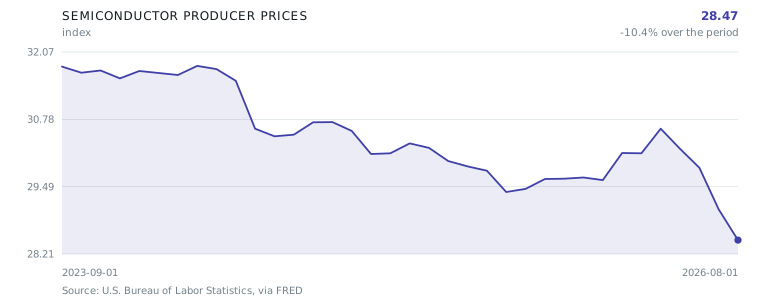
Bulls point to a semiconductor producer-price figure of 28.472 on Aug. 1, 2026, as a sign of firming chip prices. Skeptics can reasonably ask which country, base period and monthly series are being described; without that, a single daily-looking number is weak evidence for a price turn. For investors, the more useful signal is whether equipment lead times, power connections and rack deployment dates move together.
A regulator can reduce panic; it cannot shorten the time needed to permit power, install cooling or qualify memory parts.
ChangXin Memory Technologies reported key progress on a new memory cell architecture intended to boost memory density. Memory is one of the tightest physical constraints in AI systems, so any density gain matters. The announcement, however, is still a company statement. The distance between a cell architecture and high-volume manufacturing is measured in yield, defect rates and tool availability, not in a press release. For AI servers, higher-density memory can reduce the number of modules needed per token, but only if the architecture survives packaging and thermal constraints.
Factory pilots are not factory fleets
UBTECH said its robots will handle logistics at Volkswagen factories in China. That is a concrete counterparty and a concrete task: moving parts and materials inside plants. The commercial test is whether the robots operate through shift changes, line rebalancing and safety stops without requiring engineers to intervene every few minutes. A logistics pilot can become a purchase order, or it can remain a demonstration.
Black Lake’s CEO said China’s manufacturing sector is leapfrogging into agentic AI and exporting that approach globally. The language comes from an interested party, so the burden of proof is high. Agentic systems can matter if they reduce downtime, optimize inventory and coordinate machines in real time. They do not matter because the term sounds newer than automation. The export statement is even harder to verify because it depends on foreign customers, local compliance and service networks.
China accounts for about 5 per cent of the equipment and materials directly supplied to the US chip industry when measured by country of manufacture. That number cuts both ways. It suggests the direct equipment link is not dominant, but it also shows how much of the supply chain is counted elsewhere. A factory’s nationality on a customs form can hide upstream components, minerals and subassemblies.
Policy can steady sentiment, not supply chains
Market signals around the build-out are also mixed. Mainland Chinese investors bought more Hong Kong stocks than they sold for a fourth consecutive month in September. That is a sustained flow, but it is not automatically conviction. Southbound buying can reflect relative valuation, index changes, currency positioning or arbitrage shaped by capital controls, as much as confidence in AI capex.
China’s top securities regulator signaled fresh support for the domestic A-share market by convening a symposium after a sharp tech sell-off. Meetings matter because they coordinate brokers, funds and listed companies, but they do not create the underlying demand for compute or robots. A regulator can reduce panic; it cannot shorten the time needed to permit power, install cooling or qualify memory parts.
The open question is whether Beijing-linked capacity becomes billable utilization. Announcements can move markets, but the next evidence will come from electricity consumption, server imports, memory yields and robots that stay on the factory floor after the pilot team leaves.
- 01China Mobile said it tripled capacity at its largest intelligent computing hub in Inner Mongolia.
- 02Mainland investors bought more Hong Kong stocks than they sold for a fourth straight month in September.
- 03ChangXin Memory reported progress on a memory cell architecture intended to boost density.
- 04UBTECH robots are set to handle logistics at Volkswagen factories in China.
- 05China accounts for about 5 per cent of equipment and materials directly supplied to the US chip industry by country of manufacture.
Interpretation, not reporting. The facts above carry their tiers; this is one correspondent’s reading of them.
I read these announcements as a map of bottlenecks, not as proof of momentum. China Mobile’s tripling figure looks decisive until you ask what is plugged into the racks. ChangXin’s memory architecture may matter, but only yield and packaging turn a cell into sellable capacity. UBTECH’s Volkswagen logistics work is more interesting than the phrase agentic AI because it has a counterparty and a task. The regulator’s symposium and four months of southbound flows can steady sentiment, yet neither builds a data center or signs a power contract. If Inner Mongolia capacity shows up in higher utilization and if memory progress survives manufacturing, the supply-chain story strengthens. If the robots remain pilots and the market support stays rhetorical, the mosaic is just that. My test is unglamorous: power connections, cooling water and deployment dates. Until those appear, I treat the build-out as real but unfinished.
— Rafael Imai
Every claim in this article, and what it rests on
We do not ask you to take our word for it. Each statement below carries its tier and its sources. Where sources disagree, you get both accounts and what would settle it.
The semiconductor producer price index was 28.472 on 2026-08-01.
Mainland Chinese investors bought more Hong Kong stocks than they sold for a fourth consecutive month in September.
China Mobile tripled the capacity of its largest intelligent computing hub in Inner Mongolia.
China accounts for about 5 per cent of the equipment and materials directly supplied to the US chip industry when measured by country of manufacture.
Black Lake's CEO said China's manufacturing sector is leapfrogging into agentic AI and exporting that approach globally.
China's top securities regulator signaled fresh support for the domestic A-share market by convening a symposium after a sharp tech sell-off.
ChangXin Memory Technologies reported key progress on a new memory cell architecture intended to boost memory density.
UBTECH robots will handle logistics at Volkswagen factories in China.
The case against this story
Written by an adversarial reviewer, not the correspondent
The story assembles a selectively bullish mosaic of China's tech and manufacturing sector from corporate press releases, CEO opinions, and forward-looking plans, then caps it with a granular statistic that lends false quantitative authority. Several claims are self-reported ('key progress,' 'tripled capacity') or predictive ('will handle logistics') rather than independently verified outcomes. The CEO quote about 'leapfrogging into agentic AI' is promotional language from an interested party, not structural evidence. Critical counter-evidence is absent: US export controls on advanced semiconductors, entity-list restrictions on firms like ChangXin Memory, overcapacity risks in computing infrastructure, and the wide gap between announced deals and deployed robotics. The narrative also conflates policy signaling (a symposium) with material market support, and presents net southbound Stock Connect flows as confidence without noting they can reflect capital-controls-driven arbitrage rather than genuine conviction. A reader gets an impression of unstoppable momentum that the underlying evidence—mostly announcements and intentions—does not fully support.
Who benefits from this framing: Chinese technology companies seeking investment, partnerships, and higher valuations; the Chinese government's narrative of tech self-sufficiency and industrial advancement; bullish fund managers and sell-side analysts positioning in Chinese tech stocks; companies such as Volkswagen, UBTECH, and Black Lake promoting their China operations to investors and customers; and data publishers and newsletter vendors monetising demand for China-tech intelligence by packaging scattered corporate announcements into a coherent growth story.
Report an error in this article
Subscriptions open at launch
Future Systems Review will be a paid publication. Reading is free while we build the archive — leave an address and we will write to you once, when subscriptions open.