
Memory sell-off tests the AI hardware premium
A week of memory-share pressure and mixed iPhone signals is forcing investors to separate AI demand from durable margins.
 Rafael ImaiCompute, chips and power
Market accounts describe a sharp sell-off in Asian memory-chip stocks and growing doubt about the durability of AI-driven profits. The semiconductor producer price index was 28.472 in August, while device-side chatter points to mixed iPhone demand, component price pressure and Tim Cook’s third China visit. The key question is whether strong AI demand can survive component price pressure without eroding margins.
A semiconductor producer price index at 28.472 in August sits beside a sharp week of selling in Asian memory-chip stocks, and the combination is uncomfortable for a market that has been paying an AI premium for hardware. One number does not make a trend, and one week does not make a cycle. But together they put the same question in front of device makers and chip suppliers: who still has pricing power?
The index level is a single reading. Without a second month, it cannot show whether prices are cooling, stabilising or accelerating. It can only mark a reference point. In a normal hardware cycle, that would be enough to prompt caution. In an AI-led market, it becomes a test of whether strong demand can still be converted into durable margins. That is why traders are treating the August number as more than background.
By market accounts, the sell-off in memory names was sharp, with pressure described around Samsung, SK Hynix and CXMT despite strong AI demand. The move is being read by traders as doubt about how long the sector’s AI-driven profit boom can last. That is not the same as proof of a downturn. It is a sign that the burden of proof has shifted from demand to durability. A week of selling can be routine, so the important detail is whether it persists.
The market is not asking whether AI is real; it is asking whether the hardware bill keeps growing faster than the revenue it supports.
Device chatter is mixed, not broken
Tim Cook began his third visit to China this year, according to the same market accounts. The trip matters because China remains a place where premium smartphones can either support margins or expose them. Demand signals for Apple’s new iPhones are described as mixed, which is a familiar condition during any launch window but still important when component costs are moving. The visit is a signal of attention, not a guarantee of demand.
Device-side accounts say India remains a key market for global smartphone makers. That fact is structural rather than new, yet it changes the arithmetic of volume: a market that large can offset softness elsewhere if pricing and distribution hold. If it does not, mixed demand becomes a larger problem. In other words, scale can hide weakness, but only for a while.
The smartphone sector is also said to be facing component price pressure. Memory is not the only part of that bill, but it is one of the clearest places where AI-related demand can collide with consumer-device economics. When parts cost more, either the maker absorbs the hit or the buyer pays it. There is no third option.
The margin question is physical
The market is not asking whether AI is real; it is asking whether the hardware bill keeps growing faster than the revenue it supports. Memory sell-offs, Cook’s China trip and mixed iPhone signals are separate threads, but they meet at the same point: hardware economics depend on prices, volumes and component costs holding together.
The PPI figure gives one number, but it is too thin to carry the whole argument. The equity move is too short to prove a structural turn. The device signals are too broad to identify a winner or loser. What remains is a set of conditions to test. None of these items alone settles the argument.
The thing to watch is whether pressure in memory shares and component costs starts to appear in actual device pricing. If premium phones and AI-linked hardware can carry higher component costs without losing buyers, the current wobble may be routine. If they cannot, the premium begins to look like an advance against uncertain demand.
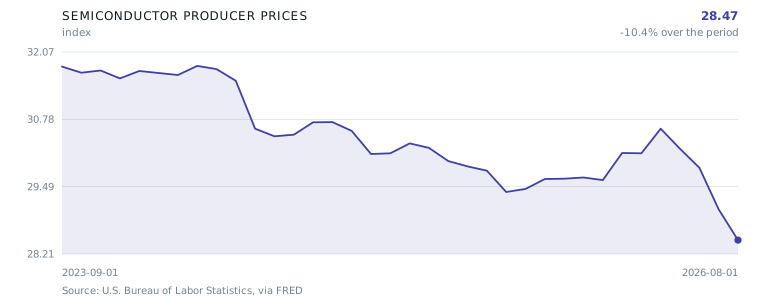
- 01The semiconductor producer price index was 28.472 in August.
- 02Market accounts describe a sharp sell-off in Asian memory-chip stocks this week.
- 03Pressure was described around Samsung, SK Hynix and CXMT despite strong AI demand.
- 04Tim Cook began his third visit to China this year.
- 05The smartphone sector is said to face component price pressure.
Interpretation, not reporting. The facts above carry their tiers; this is one correspondent’s reading of them.
The useful signal here is not the sell-off itself, but the mismatch between AI enthusiasm and hardware economics. I would treat the PPI reading as a placeholder, not proof: one number in August cannot establish a pricing trend. What matters is whether memory strength can survive component pressure and mixed phone demand at the same time. If pressure around Samsung and SK Hynix persists while iPhone demand stays unclear, the market is likely repricing durability rather than simply moving on from a hot trade. If device demand proves steadier than the chatter suggests, this week will look like noise. I would weigh China heavily, because Cook’s third visit suggests the region is still pivotal to premium devices. The open question is who has pricing power when the bill for parts arrives.
— Rafael Imai
Every claim in this article, and what it rests on
We do not ask you to take our word for it. Each statement below carries its tier and its sources. Where sources disagree, you get both accounts and what would settle it.
The semiconductor producer price index was 28.472 in August 2026.
A sharp sell-off in Asian memory chip stocks occurred this week.
Samsung, SK Hynix and CXMT shares were under pressure despite strong AI demand.
The memory-sector sell-off signals growing investor doubts about whether the sector’s AI-driven profit boom can last.
Tim Cook began his third visit to China this year.
Demand signals for Apple’s new iPhones are mixed.
India remains a key market for global smartphone makers.
The smartphone sector is facing component price pressure.
The case against this story
Written by an adversarial reviewer, not the correspondent
The story stitches together loosely related items — a weekly memory-chip sell-off, Tim Cook's China travels, iPhone demand chatter, India's smartphone market, component prices, and a single PPI data point — into a coherent bearish tech narrative that the individual claims do not collectively support. A one-week stock move does not establish structural doubts about AI profitability; it may simply reflect profit-taking or macro rotation. The claim grouping Samsung, SK Hynix and CXMT shares together is compromised if CXMT is not publicly traded, making the comparison misleading. The semiconductor producer price index figure of 28.472 is presented at the highest confidence level without a named source and in a format inconsistent with standard PPI reporting. Meanwhile, 'mixed' iPhone demand signals are almost always true during any launch window, and 'India remains a key market' is a years-old structural fact, not new evidence of sector stress. The story's framing amplifies routine market noise into a systemic narrative.
Who benefits from this framing: Short sellers and bearish traders in semiconductor and memory-chip stocks benefit if readers accept that the AI profit boom is faltering. Activist investors pushing for buybacks or dividend increases over AI capital expenditure benefit from framing that questions whether AI-driven profits can last. Tech-sector competitors benefit from negative sentiment directed at rivals. Media outlets benefit from dramatic market-narrative framing that drives reader engagement and subscription conversion.
Report an error in this article
Subscriptions open at launch
Future Systems Review will be a paid publication. Reading is free while we build the archive — leave an address and we will write to you once, when subscriptions open.